Showing posts with label Oman. Show all posts

Navigating the green mountain - Jebel Akhdar, Oman

Imagine you're just a quiet bloke. You live in the hills, just about as far away from civilization as you can manage. Your electricity trickles in on a single wire that hangs from a concrete pole that is currently being used as a butt-scratching device by the neighbourhood goat. Your water flows from one of ten secret mountain springs through a falaj system as ancient as your stories. Your missus is outside cleaning the guts out of your sacrificial cow with your eldest son. Later, they'll heave it into a pit filled with smouldering coals and cook it until the meat is so soft it dissolves in your hands. The mountain breeze whispers through your open door - it's always open, to your family, friends, and even the feral kittens your daughter likes to bring home. And then you hear your granddaughter chirping from outside - "Jadda, these people want to take photos of me. Do we let them?"

Can you put yourself in that position? Pretend for a moment, that you are this man. The world we live in allows him to move if he wishes, but he stays here, in his village with its peace and tradition. And then, when tourists come, they take photos of his front door, the off-cuts of his forthcoming feast, his front garden, his drainage system, his grand daughter, and even the ruddy goat with the itchy bum. In Australia, he'd set his kelpie on you, probably with a string of invective to accompany. In other places you may get shot for trespassing. And yet, in Oman, even on holy days (we visited over Eid al Adha), when the only words you can say are hello and thank you, this man will smile and shake your hand. Don't ever say that people are unkind in the Middle East. You'd be wrong.


Al Ain is one of around thirty tiny villages scattered in the folds of the Saiq plateau, and one of the better ones to visit, not only because of friendly grandfathers and gorgeous little girls. This village takes up much of the vista that fills your eyes from "Diana's Viewpoint" - famous for the princess who stood there, rather than the picture it presents. It continues its mountain life, suspended in time and apparently space, on the edge of its cliff. It's not just an old village, with it's crumbling stone, timeworn paths, sagging foundations and secret tunnels. It's also a working community. There are fields of corn, wheat and vegetables, tiny orchards of fig and pomegranate with their land eroding and likely to take the trees to the depths of the valley before too long. Further afield you'll also find walnut, palms, grape vines, juniper and roses.

From here in Al Ain, you can also take a relatively easy walk to the nearby village of Al Aqr, and past the spring that feeds crystal clear water to the village. Al Aqr is famous for its roses, which are in bloom by April, and harvested in the traditional fashion just before the worst of the summer begins. At that time you can watch them harvest into terracotta urns for processing. At others, villagers will allow you to stumble through their tiny alleys, over lithic wadis, and almost off the edge of their cliffs, with the most incredible view in the world.


For some reason, even though I've lived nearby in the UAE for 5 years, I had forgotten just how exotic this part of the world can be.

What to do

The region is paradise for trekkers and amateur geologists. For those who want more information on the walks, it's best to buy a guide or ask at your accommodation for a map (this will probably be hand-drawn). The Oman Off-Road Explorer is a bible. You must get a copy if you want to spend any serious time in the area. The maps are excellent, and without it, you will waste all your time driving up the wrong roads. They also have a website where you can ask questions about particular regions (although the site has little information). I have included a map that I have taken from various sources - click on it to zoom.

The better known walks are:
  • The little one already mentioned from Al Ain to Al Aqr.
  • This one, which will take you a little further and through two more villages, all the way to Saiq.
  • There is another good village trek from Wukan to Hadash, through Al Qawrah, but this is at least four hours, and challenging in parts. This free link will show you where to go, and give you the harder option, between the same towns, but around the Ghubra Bowl (amazing but hard!) This area is approached from the north.
  • Wadi Bani Habib is worth a look - an uninhabited village, but beautiful nonetheless. 
  • as is Al Ghaba, a wrong turn we took (to the right on the way up the mountain when we should have continued straight to the Saiq plateau.) - a working village in a steep wadi.

Getting Around

It's fairly easy to do this yourself (despite the lack of decent maps online) - people really are very friendly so long as you behave. But you will need a 4WD to get past the checkpoint soon after Birkat al Mawz, or if you just find you get more out of a trip with a guide, then you could try one of the many trek and tour operators like the following:
  • For trekking with a guide, the best are probably These blokes
  • For an easy day in a 4WD (you can see the Saiq plateau in a day-trip from Muscat), try Gulf Leisure or Panorama
  • Or for something tailor-made, try Audley

Staying

  • We're big fans of the Golden Tulip (affectionately nick-named the 'Golden Toilet'). It's not fancy, and it's not super cheap. But, it's in the best position (between Nizwa and Birkat) to explore the area, it's clean, the service is reasonable, it has large rooms, and a lovely pool surrounded in plush astro-turf. And the biggest plus - it has wine. If you look hard enough, you'll probably find a deal outside of holidays. Book early if you are going during a school break. They make super curries and fairly average buffets, and the pool barman seems to have a love of eighties ballads. It's a great place to relax after a day of walking.
  • Sahab Hotel is a fairly new resort almost smack on Diana's Viewpoint, that will appease the luxury hunters. The restaurant is probably one of the better ones in the area too, and tries to serve some authentic regional (if not entirely local) cuisine. They have an infinity pool that pitches off into the sunset, and a native garden speckled with fossils. They also arrange activities onsite, so it's good for lazy planners. To be honest, we might end up here next time. At this stage, no liquor license.
  • Until Sahab opened in 2011, people always stayed at the Jabal Al Akhdar hotel. It's well positioned and cheaper than the Sahab, but a bit tired.
  • Misfah Old House is where to go if you really want to immerse yourself in Omani life. It's a little further out, and closer to Jebel Shams, but if you've got your own 4WD and you don't mind giving up the plonk for a few days, it's got a great reputation. It's only small and accommodation is basic, but it's fairly inexpensive and the cuisine is authentic Jebel village food, cooked in village kitchens around the house. It's in the beautiful and traditional hamlet of Al Hamra, so no buffoons allowed. Walking and horse riding trips can be arranged from onsite.
  • For something a little outside the box, contact Hud Hud travels, who will set you up in a luxury camp and organise all the hard stuff for you. 

Eating

This gets a little tricky. Unfortunately, Oman is still an emerging tourist destination, and so both information and the physical presence of secondary tourism businesses (like restaurants) is a little lacking. So apart from the above, I can't help you out much with where to go. I CAN tell you what you should look out for:
  • Qawha (kahwa) - Omani coffee, served in thimbles and flavoured with cardamom, very similar to Emirati Gahwa. If you don't get to drink this at least once, you're going to the wrong places.
  • Halwa and Lokhemat (doughnut balls in honey) are accompanyments to the coffee, and also found in many other parts of the gulf region and beyond. Here, halwa is usually egg based rather than tahini, and so more like a firm custard, and flavoured with spices and rose water.  Lokhemat (we call them lgeimat here) are likely to be flavoured with cardamom, and lime.
  • Oman Chips.... Yes, I know, not really gourmet, but considering a previous commenter (who doesn't understand tongue in cheek humor) described them as a "cultural expression", I thought I'd better include them. They are yummy - and definitely a step up from sweet chilli chips, and available everywhere.
  • Harees is a wheat based paste similar to a porridge and usually served with spices, ghee and chicken. It's sweet equivilent, sakhana, is flavoured instead with date molasses, diluted with milk and is loved by all who come near it.
  • I did manage to find Kabuli rice (apparently not hailing from Kabul) on the menu at the Sahab - a spiced rice dish with nuts and potato (and in this case, chicken). The other rice dish to look for is Aursia - a mashed rice dish, heavily spiced.
  • Mishkak is something you will find everywhere - barbecued meat on a stick, marinated in a mild Omani spice blend. Hard to go wrong.
  • Maqdeed is a dried meat, either served before Eid, or carried by travellers.
  • Maqbous is the traditional main meal - a rice and meat (usually chicken) dish that many would compare to biryani, usually tinged with saffron, and often served with a spicy kick. Most buffets should have this.
  • Shuwa is the delicacy to keep your eyes peeled for. It is really only a festival dish, and resembles what we call Ouzi here in Dubai. Slow cooked whole cow or goat in the ground with a multitude of herbs and spices. I'd really hoped the hotel would serve it during Eid. Aching to try it - if you find it, let me know.
  • Of course, try the local fruits when in season. Look for figs (also dried), pomegranates, stone fruit, citrus (also preserved), and walnuts. You will find these fresh, but also in many local dishes. 

There's plenty more information available on the area on the web, but you need to know what you are looking for. Villages of course are spelled phonetically, and this can differ widely. Google maps only lists the Saiq village, however satellite images will show you where other villages and trails are. There's so much more to it than I've mentioned here - if you can't find the information online, ask at your accommodation. If you have the time, look up the Jebel Akhdar War, and find out why there is a military base in the area to this day. You can also find plenty of evidence of fighting in the relics left around the hills. Look up caving in the hills, and further out, towards Jebel Shams, particularly Al Hoota cave. And of course, if you're in the area, look at some other antique architecture in Birkat al Mawz, Jabrin (Jibreen) and Bahla.

And say "Hi" to those lovely kids in Al Ain for me xx.


Camping, glamping and dune stamping. Desert accommodation in the UAE and beyond

Weekend breaks just ain't what they used to be. None of that popping into the hills behind town, buying organic apples at a roadside stall, wine tasting on the way, rolling fields, fragrant gums, roos doing their kamikaze leaps across the highway in front of your speeding car at dusk. No more country pubs for lunch, farmers markets in paddocks, cheese sampling in stinky dairies. Ahhh, those were the good old days.

But these are the good new days. This arid region might not offer much in the way of greenery, cellar doors and local produce, but there's a whole lot of sand to explore. Only twenty minutes drive from the spires of Sheikh Zayed Road will bring you into a beige sea that tilts and rolls just like the blue one. Its texture changes  - some regions are rusty and treacherous, others like peachy crumpled blankets, and more are flat and stony, the colour of parched bones. The sands reflect the sky's moods just as the watery depths do. They are blindingly bright, mousey, red, purple or black. It's amazing how different something can look when it's really all the same.

Staying in the desert is something that everyone must do when they come to Dubai, or anywhere around here really. Even in summer, when the back blocks of this dusty land resemble the sunny side of Mars, when the very air melts, there are options. If you live here, then there is really no excuse.


There are three styles of desert experience. First, the self-arranged camp. But I'm no expert on this, and tend to sympathize with Debbie in this post. If that's your piece of cake, I'll start you off with Time Out's suggestions . Then get yourself down to Carrefour, spend 3000AED on gear that you'll only use once, and I'll titter over my Mai tai while I lay back poolside at Qasr al Sarab and think of how we've just spent the same amount of money for entirely different experiences. (I know, I know, it can be good. But ONLY if you're kitted out, know what you are doing, and where you are going.)


Secondly, is the organised camp. This varies in quality from five stars down to about negative one, so make sure you do your research, and have reasonable expectations before you trek out there. Most of the 'dune bashing' organisors will also offer an overnight stay that is tacked onto the evening 'safari' (safari means "a journey or expedition, for hunting, exploration, or investigation", so this term has been entirely exploited). To be honest, if you don't have much to spend, don't mind a bit of kitch and noise, and it's not summer, then this could be a good option. Prices will include all manner of gimmickry like camel rides (a circle 20m in diameter, not an idyllic sunset wander over the dunes), henna painting (careful, you may be allergic), trying on of national costume (100% polyester, worn by hundreds before you), belly dancer and super duper authentic buffet of soggy spaghetti bolognese and bland chicken curry followed by watermelon chunks and crusty custard. Sleeping conditions are basic, but most camps have toilets and showers. All operators are much of a muchness - the tip is to get a deal. Groupon and makshoom will have them going now and then, so if you plan ahead you can really save some cash.

If you want something a little more towards the upper end of the spectrum (yes please!), have a look at these (in ascending order of quality/authenticity)

  1. Gulf Ventures - This is where Dubai Drums hold their full moon drumming, and it's a reasonable camp, just a little better than the 'safaris' mentioned above. It sits in a lovely hollow in a quiet area. Food is a little better (arabic BBQ), and the camp itself is sheltered and reasonably pretty. If you can partner it with full moon drumming (my experience linked), even better. Licenced camp, no BYO. Overnights start at 445AED for min 4 sharing a tent, or you can take the tent itself for 2045 for the whole weekend. Includes pick-up/drop-off from anywhere in Dubai.
  2. Arabian Incentive is a fairly recent addition to the dunes of Ras al Khaimah. It's a more authentic experience involving activities like horse or camel treks over the dunes, falconry and 4WD expeditions (rather than pitching and fishtailing over crowded and rutted dunes just to freak out the grannies in the back). There is some of the standard tack on offer (belly dancing, shisha), but over all, it's better presented. The overnight accommodation is fairly basic, and food is served buffet style, but like the above, is a little better than the norm and at least keeps things in an arabic vein. They also offer the occasional drumming session, and other events like this will crop up now and then. Other benefit is the proximity to this beautiful section of desert spotted with ghaf trees. 340AED (about $100US) per person, pick up and drop off from a meeting point in Dubai is an extra 60AED. You can BYO booze, but best to check with operators first.
  3. Liwa Desert Safari will take you way out back into the real desert. There's no organised campsite, no belly dancer, none of that stuff. Just Land Cruisers, 100-meter sand dunes, a look at some far-out sights in Fujeirah and Dubai, including a date farm on the edge of an oasis, and then a quiet camp set up in the middle of nowhere for a barbecue dinner and a sleep in the arabian wilderness. Make sure you book the right safari, because the group offers many styles of adventure with prices varying from about 1000AED upwards. Not for summer visitors.
  4. Platinum Heritage is the real deal, and more. The safari takes place in the desert conservation near Al Maha (mentioned below), in 1950s Land Rovers. They take you on an expedition to see the Arabian oryx, and local flora, and then there is a falconry display. Dinner (limited to 40 guests maximum) is truly authentic, a 4-course meal with deliciousness like ouzi (whole baked lamb with biryani style rice) and lqeimat (like doughnut holes, smothered in date honey), and is followed by storytelling and cultural entertainment. Breakfast with a bedouin accompanies the morning. Accommodation is in natural fibre tents. Overnights are 795AED per adult, and 595 per child, so it's not cheap. You can opt out of the overnight and go home after dinner for 495/395. They also have more expensive options involving Mercedes G500s and 6-course meals and more, starting at 1295AED. Part of the fee goes to conservation of the area. Alcohol can be requested, but must be done beforehand as it is a camp designed to be of authentic Bedouin style and there is none on site at most times. I found out about this amazing tour through a twitter mate - Daniel at Al Arabi, and I've booked one through him (email link) for my husband's birthday next week. Expect a more detailed post shortly.
  5. For something further afield, there's Wadi Rum, Jordan, which I have posted about previously here. Its an area with little on the luxury side, and so it's best to find a small camp in an area that appeals to you (it's a big wadi) and enjoy the rustic pleasures for what they are, shunning all luxuries and absorbing bedouin life. Scott Dunn will set up bespoke camps in Wadi Rum, but also in Oman, in either the Wahiba sands area (more on this blow) or up in the mountains that frame Muscat and the northern coast. Another crowd, Elite Oman, have the glamping down pat, complete with queen size beds, fluffy pillows and private chefs.If you don't want all that, then maybe try Responsible Travel, with tents starting at 40 Rials (just over $100) that might not have all the mod cons, but keep your soul clean.

Thirdly, is the desert resort. This ranges from faux glamping (the term 'tents' could only be used loosely) through to desert castles like Qasr al Sarab. There's several around, the more notable of them being:

  1.     Bab al Shams - This is an adobe brick fortress style building, just past the wasteland that joins Dubailand to the more pristine areas of desert, less than an hour out of Dubai. The surrounding sands are golden and not as alluring as those closer to Al Maha, but you will find oryx if you look hard enough. You might even find a sheikh trotting past on his noble steed from the nearby equestrian endurance club. But it's more about the inside than the out. It's an incredible setting, with pale turquoise pools, and trickling fountains joined by a falaj system that encompasses the entire resort. The walls are the same dusty gold as the surrounding desert, but inside it's ornate, plush, genie in a bottle styled. Five star, complete with all the trimmings (day spa, range rover expeditions, dinner on scarlet rugs under the stars...). Starts at under 1000 AED per room per night (in summer), rising to double that in peak seasons. Can even be experienced in summer as the pools are chilled and there's plenty of air conditioned inside space.
  2. Al Maha is the other big one in Dubai. Accommodation ranges from private chalet to sprawling pavilion 'tent' (so much more than a tent). Everyone gets a private pool. In fact, it's private everything, and no kids are allowed. The cuisine is exceptional, it's in the best part of Dubai's desert, and you never see another guest unless you want to. Just in case that isn't enough to make you romantic, it's just about expensive enough to scare someone's pants off. At the absolute peak of summer, rooms start at 4000AED. The Presidential suite will set you back about 20K. You can however book a daytime experience if you just want to have a look around. They start at 550AED including lunch, or visit Lime and Tonic's page for their 'spa day' offer.
  3. Arabian Nights is a fairly new village between Abu Dhabi and Al Ain, and stays fairly true to traditional Emirati style. Accommodation is in fort towers or barasti huts, and has a good level of luxury without being bloated with opulence. There's a pool and air conditioning, so summer visits are possible. The highlight here is the dining, which prides itself on being true to the Emirati traditions, something surprisingly rare in the area (most other Arabic menus tend to veer closer to Lebanese cuisine). Prices start just under 1000AED per room per night.
  4. Next we have Qasr Al Sarab, which rests in the Abu Dhabi emirate between the Liwa oasis and the hundreds of kilometres of sandy sea stretching into Saudi Arabia known as the Empty Quarter. It's fortress style, like Bab al Shams, but bigger, bolder, more isolated. This area of desert is rose-gold, and owns the largest dunes in the world, but many who go never leave the resort. Blogged previously here. Prices have dropped a little, and you will find the standard rooms range from 1000AED per room in summer up to 1500 at cooler times. Of course there's plenty of non-standard accommodation if you need a bit more space (in your wallet)
  5. The Banyan Tree has a little of everything. It's based in Ras al Khaimah, and they also offer a beach resort nearby. The desert retreat is similar to Bab al Shams in style, but with a more contemporary than arabic style. It's still exotic in every way, but you'll find clean lines and neutral colours rather than the ornate and plush interior of the other. In other ways it competes with Al Maha, with private villas or tent-style dwellings, but children are allowed, and there is even a kids club. It's got all the activities you would expect to find, a nature reserve, plus a 4000 sq metre hydrotherapy spa. Prices range from just over 1000AED, but you're usually looking at around 2000+ for a pool tented villa.
  6. Back to the wahiba sands in Oman, just a couple hours drive out of Muscat (about 7-8 from Dubai) there are a couple of well known desert resorts that should not be confused with each other (I accidentally booked the wrong one, but luckily all turned out well). 1000 Nights Camp is glamping of a sort (tramp-glamping?), with camel-hair tents, and a super majlis with lovely food. Entertainment is tasteful, with omani music, drums and traditional dancing (finally we get away from the belly dancers!) Officially there is no alcohol, but you can bring in wine and drink it quietly in your own area. It's an experience that warrants its own post, so expect one soon. Prices are around the 50 Rial (500AED) mark per night in the cool season - avoid in the summer. Although there is a pool, the tents are not heat-friendly. 
  7. The luxury option is the other one - the one I meant to book - known as Desert Nights Camp. It's double the price and then some, but for that, you might actually get a little more of a look at traditional Oman, including a trip to a bedouin home, and some traditional food such as Shuwa, a dish often talked about in Oman but rarely found. They also have a communal games room and a not-so-traditional cocktail bar. Ah well, next time...
So - enough options? C'mon, time to get some sand in your pants...


Oman - Birkat Al Mawz

I read recently that Oman is actively trying to embrace tourism, but it's not yet that evident all over. The country has built all its five star hotels in one city, most of them far enough out of Muscat so nobody ever actually leaves the resort. There is an outrageous lack of street signs, even in Arabic. Historic and natural wonders tend to close over public holidays. You can only fly to Salalah from Muscat, and it's 1000 kilometres from everywhere. All the most beautiful areas only have unlicenced hotels. There's no McDonalds on the highways. They have an overt love of squat toilets and an apparent loathing of toilet paper. Crisps only seem to come in chilli flavour. The list goes on.

An efficient tourism industry is something that is not built overnight, and like many countries that open up after long periods of touristic dark ages, Oman is still on the bottom rung of the ladder that sees Paris and the Maldives at the top. It's a country with plenty to see, that is of little doubt. The problem is finding the sights. It's interesting watching different economies realise that the tourist dollar is something they want, and how they go about getting it. In Oman's case, it almost appears like they believes they can come out and say "it's ok to visit, we want you", and all will be well. I'm sure that's not actually the case, and that what I am looking at is a work in progress rather than complete arrogance. It simply shows a tourism budget in infancy, something that needs growth to grow, if you get my drift. Like Jordan, they kind of have to wait for people to come before they can put more effort in. But the question remains - will people come if it remains so hard? Chicken and egg issues are at play.


Google active map linked here
So, I'm going to do my little bit for the Omani Tourism Department - and give you the pointers you will need to get you to some of the good bits over the next few posts.

I'm going to start with Birkat al Mawz, because it's pretty much the starting point for a trip to the great unknown that is the Hajar Mountains just inland of Muscat. It's not on Google maps. It's definitely not on Apple Maps, who can't even manage to find the interior city of Nizwa, no matter how I spell it. It's about halfway between Nizwa and Izki, on the northern road, just a few kilometers from the Golden Tulip Hotel. Not only is internet mapping deplorable in the area, so are GPSs and signposts. So I suggest you learn arabic, or bookmark the positions before you go, or, the best solution, go with someone who's been before.

Google active map linked here
Let's assume you finally get to Birkat al Mawz. You'll see the fort. It's close to the entrance of the village, and signposting will send you there. It's also at the base of the road that leads up Jabal Akhdar, the green mountain (more on that later). It's old, beautifully symmetrical, turretted, carefully restored,  houses an ancient and large falaj system and palm groves. But if it's Friday, a public holiday, before 10, lunchtime, after 4, or the wind's blowing from the north east, then it will probably be closed. That's a pity, because this is the only thing you will find information on when you research the village online. But don't give up.

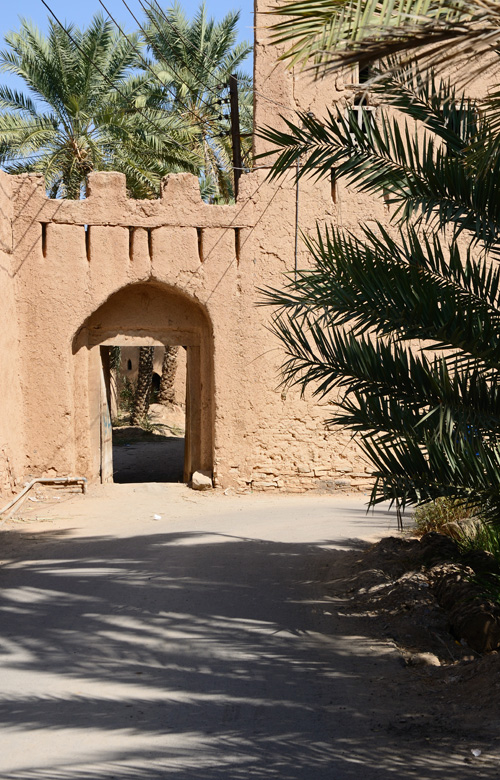
Wave at the locals milling around the gazebo - talking cricket, trading goats and smoking cigarettes, then jump back in your car and go where you you think you probably shouldn't, into the belly of the village. There's no signs - don't even bother to look for them. Just go straight where the signposts point you left to the fort. You'll go over some sky-high speedbumps, so take it slow and watch the modern candy coloured and double-storey arabic housing give way to the more traditional walled and inner courtyard single story dwellings. Palms hang over white crumbling stone and doors made of aluminium, emblazoned with tulips and crecsent moons are coloured with jade, turquoise and rust. Soon, you will see streets to the left that don't end in white houses or russet mountain, but in sepia ruins. And then the ruins will also be on your right. Keep driving slowly - they're one layer back, behind the show house on the corner. Park. Walk.

Make your way towards the mountains - you'll pass locals. Some will stare. Some will glare. Kids might chase you, practice the English they're learning in school, ask you back to their house, but Father will probably step out and rush them inside as soon as he sees a camera. Practice your few Arabic phrases, and you'll probably get a nod and a smile from all of them.

Soon you'll see that the rendered and whitewashed walls have finished, and you'll be confronted with weathered Adobe brick in 50 shades of beige. It's muddy, riddled with straw and powders to the touch. It's no wonder the ruins are so, but a shame. Much of it still stands - enough to see the form of a village - walls, arched windows, stairs, caved-in floors, painted wooden ceilings.  The falaj still runs through the lower sections. Palm plantations fringe the outer buildings. The sky is stark and blue above you, as it always is in gulf. No clouds even for company. It's deserted, completely abandoned. Walk through at your own risk. There's no barriers, no fee, no health and safety, no people. Just you and a totally cool ghost town.

I could go on explaining, but I'd rather show than tell - photos by the hundred were taken that day - some below.